

Venue
Location
 Murmansk is the gateway to the Arctic
Murmansk is the largest city in the world located beyond the Arctic Circle, Russia’s maritime gateway to the Arctic. Situated on the rocky shore of the ice‑free Kola Bay of the Barents Sea, it has become the starting point for hundreds of scientific expeditions and the main base for studying the Arctic seas and their inhabitants. People come here to experience the harsh northern beauty, the atmosphere of a polar city, and the unique opportunity to see marine giants in their natural habitat.- Marine Mammal Research Center
The Murmansk Region is rightfully considered one of Russia’s main scientific centers for the study of marine mammals. Leading institutions are based here, and their staff have been monitoring whales, seals, and beluga whales in the Barents and White Seas for decades. - Polar branch of “VNIRO” (“PINRO” named after N.M.Knipovich) — the oldest scientific institution in the Murmansk region, founded back in 1921. PINRO staff annually conduct ship‑based surveys of marine mammals in the open part of the Barents Sea, tracking the migrations and seasonal distribution of grey and harp seals, minke whales, beluga whales, and porpoises. It is here that unique long‑term data on the state of Arctic mammal populations have been accumulated.
- Murmansk Marine Biological Institute of the RAS (MMBI RAS) — another flagship of Arctic science. Since 1984, scientists at the MMB have been studying the adaptation of various species of marine mammals to captivity conditions, having created a unique aqua complex in the city of Polyarny. The institute annually conducts comprehensive sea expeditions on the research vessel “Dalnie Zelentsy,” during which visual counts of marine mammals and birds are carried out. MMB also actively collaborates with the Kandalaksha Nature Reserve in studying the breeding colonies of the grey seal in the Barents Sea.
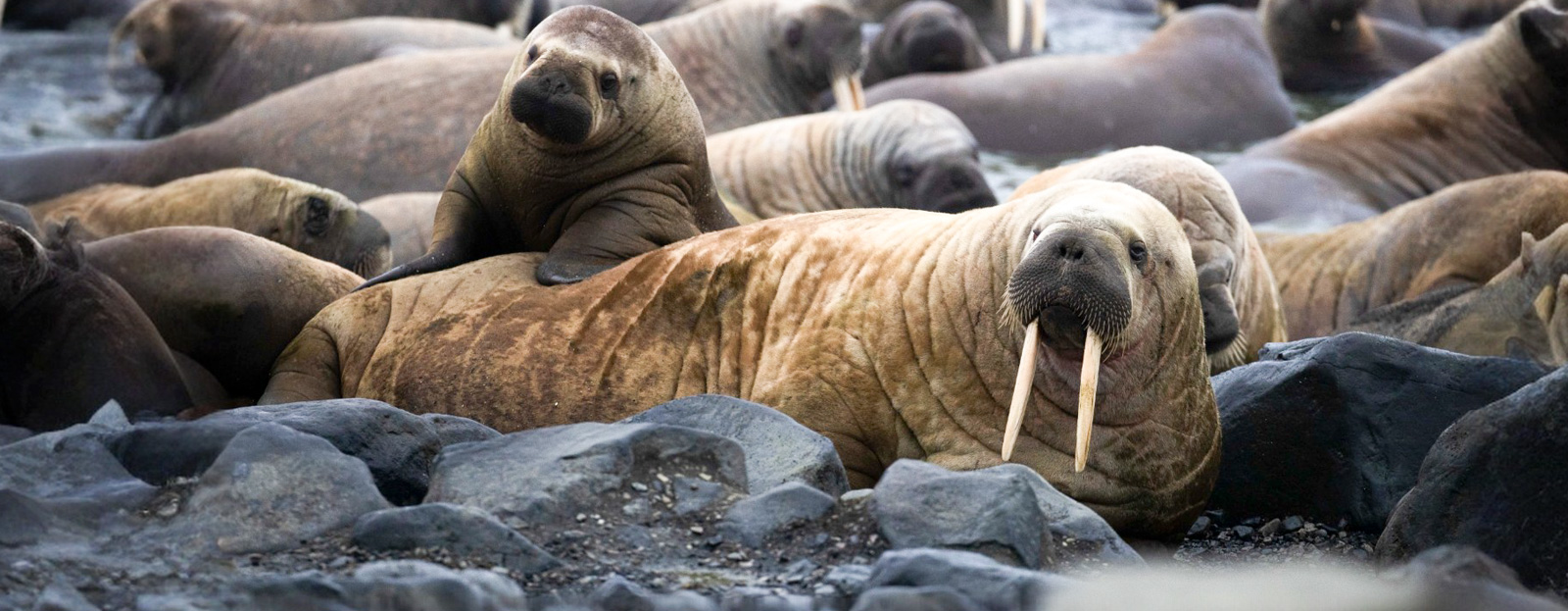
- Kandalaksha State Nature Reserve — the oldest nature reserve in the region, founded in 1932. The marine area accounts for three‑quarters of its entire protected territory. It is home to the northern sea hare (laptev), ringed seal, grey seal, beluga whale, and in coastal waters, minke whales and Atlantic walruses are occasionally found. The reserve is included in the list of wetlands of international importance and is one of the key protected areas for marine mammals in the European North of Russia.
- Teriberka and whales: a unique combination of science and tourism
In recent years, the village of Teriberka on the coast of the Barents Sea has become a symbol of Arctic tourism — and at the same time a unique scientific hub. The population of humpback whales is growing here: now these marine giants can be seen almost every day, both in winter and summer. An adult humpback whale reaches 19 meters in length and weighs up to 53 tons.
At the end of 2025, the authorities of the Murmansk Region, with the participation of scientists and the tourism industry, approved special rules for observing marine mammals. These rules are intended to preserve the populations of whales, seals, and birds and to make tourism safe both for animals and for people. Among the key recommendations are: not to approach whales with calves or pinnipeds closer than 200 meters; to limit observation time to 15–30 minutes; to adhere to a speed limit of up to 5 knots; and observation is completely prohibited from midnight to 6 a.m. Regional authorities, the tourism industry, Murmansk Arctic University, border guards, and the Ministry of Emergency Situations participated in the discussion of these rules.
Expeditions to study the Teriberka whales continue: scientists photograph the animals’ tails to identify individuals and compare them with international catalogues, take skin samples for genetic analysis to determine sex, age, health status, and diet, and also assess the impact of tourist boats on whale migrations and their food supply. This work is carried out with the active participation of the A. N. Severtsov Institute of Ecology and Evolution of the Russian Academy of Sciences (IEES RAS), a key partner of our conference.
Murmansk Arctic University is the host party.
The conference will be held at the Murmansk Arctic University (MAU) — a young but already key higher education institution in the Arctic region. MAU was established in 2023 through the merger of two leaders in regional education — MAGU and MSTU. Behind its creation lies nearly a century of history: a pedagogical school rooted in the pre‑war teachers’ institute, the maritime training of the legendary seafaring school, the mining expertise of the first Khibiny expeditions, and advanced academic‑level science.
Today, the university is a city‑forming enterprise in Murmansk and the region, training almost 100 % of the personnel needed in the region. MAI is among the participants in the “Priority‑2030” programme, is actively developing a modern campus in the centre of Murmansk, and on its basis there is a university “Boiling Point” — a platform for dialogue between the key players in the region.
The university regularly hosts major scientific and educational events: in 2024–2025, its venues hosted international conferences, all‑Russian forums, and student scientific gatherings. The MAI has established a Center for the Study of Problems Related to the Conservation of Marine Mammals and Birds, which makes it a natural partner for our conference and an ideal platform for bringing together leading experts in the field of marine biology.
Welcome to Murmansk!
Murmansk awaits you not only as a venue for the conference, but also as a city where the science of marine mammals lives and develops every day. Here, you will not only be able to exchange experience with your colleagues, but also to see firsthand what you write about in your research. Welcome to the capital of the Arctic — a place where new knowledge about marine giants is born and where something new is discovered every day.
